




Alcohol reduction by Boiling?
Prohibition was responsible for a lot
of bad things, one of them being Near Beer. This was produced by
breweries who, faced with going out of business due to the passing of
the 18th Amendment in 1917, took their finished beer and boiled it to remove the
alcohol. Non alcoholic beers have experienced a revival recently. We
have heard from some customers (and others) that alcohol can be removed
from beverages by boiling. 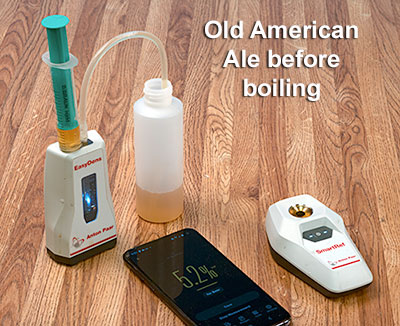
We experimented with two of our William's Brewing Kits: Fireside Ale®, a strong malty ale with an alcohol content of 7%, and our Old American Ale, an easy drinking session style beer with an alcohol content of 5.5%. Both were brewed with the usual half hour boil and 16 day fermentation period, and then transferred to a clean carboy and cold crashed them for 48 hours to try to remove all the yeast (which can produce off flavors when boiled).
The Fireside Ale® contains 11 pounds of extract, and had a starting gravity of 1.080, and a final gravity of 1.020 after 16 days. After cold crashing for 48 hours, we heated half the batch to 173° degrees F. in a Mash & Boil, and held this temperature for 1 hour (173° F is the temperature at which alcohol starts boiling). The other half was kegged and carbonated. The boiled half was then cooled, kegged, and carbonated. Upon tasting, our group of three experienced tasters found the unboiled beer better, although the boiled beer was considered drinkable, and not that bad. Everyone agreed the unboiled version significantly better. Using the combination of the Anton Parr EasyDens and SmartRef to determine the alcohol, the unboiled beer had alcohol content of 7.1%, while the beer boiled for 1 hour at 173° F. had an alcohol content of 5.7%
 Next was the Old
American Ale, a kit containing 8 pounds of extract, with a starting
gravity of 1.050, and a final gravity of 1.015 after 15 days of
fermentation. After a 48 hour cold crash, we heated half the batch to
177° F. in a Mash & Boil, and held this temperature for 1 hour. A
little hotter this time, trying to remove more alcohol than the
Fireside Ale. The other half was kegged and carbonated. The boiled half
was then cooled, kegged, and carbonated. Upon tasting, our same group
found the unboiled beer to be very good, while the boiled beer was
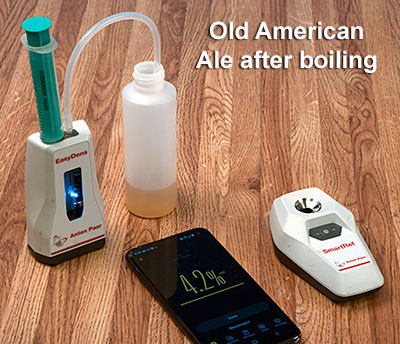
judged to be off, with a slight bite. Again, using the Anton Parr
EasyDens and SmartRef together to determine the alcohol content, the
unboiled beer had an alcohol content of 5.2%, while the boiled sample
had a content of 4.2%
Next was the Old
American Ale, a kit containing 8 pounds of extract, with a starting
gravity of 1.050, and a final gravity of 1.015 after 15 days of
fermentation. After a 48 hour cold crash, we heated half the batch to
177° F. in a Mash & Boil, and held this temperature for 1 hour. A
little hotter this time, trying to remove more alcohol than the
Fireside Ale. The other half was kegged and carbonated. The boiled half
was then cooled, kegged, and carbonated. Upon tasting, our same group
found the unboiled beer to be very good, while the boiled beer was
judged to be off, with a slight bite. Again, using the Anton Parr
EasyDens and SmartRef together to determine the alcohol content, the
unboiled beer had an alcohol content of 5.2%, while the boiled sample
had a content of 4.2%
Discouragingly, we also tasted Sierra Nevada's® Trail Pass™ Non Alcoholic IPA at the same tasting session. Everyone thought the Trail Pass™ was surprisingly good for a no alcohol beer, and without any of the flavor defects experienced with our boiled Fireside and Old American. Looking a bit further, Trail Pass™ is not boiled, but brewed with a special yeast developed by Lallemand, LoNa™. LoNA™ is not going to be available to home brewers, due to Lallemand's significant concerns about the need for pasteurization after fermentation with LoNa™, and the danger of pathogens growing in beer that is not properly pasteurized.
So what is a home brewer to do? We suggest skipping the idea of boiling and brewing low gravity beers when you want a low alcohol beer, or sticking with non alcoholic beverages. Drinking Trail Pass™ the first time was a bit unsettling, as it really does taste like a good clean hoppy beer, but we wondered, what is the point? Isn't alcohol one of the reasons we drink beer?

Comments? Send to: [email protected]
Items used in this test
