The Start of It All
I started brewing beer with a friend in my last year of U.C. Berkeley, out of curiosity after going to Wine and the People, a store with a very Berkeley name, and seeing that they had strange things like drums of malt extract dispensing malt extract by the pound, British books on making beer, dry yeast, a grain mill, and a selection of hops in both compressed whole and pellet form. The store looked a little like your typical hippie health food store of the day, but there was an energetic feel to the place. I remember naively asking one of the bearded employees who looked a bit like Jerry Garcia if it was possible to make better beer at home than I could buy (thinking it probably was not), his eyes lit up and he said something like ‘Of course, easily!’ After walking out with our first batch of ingredients for 10 gallons, we went to work.
Our first 10 gallon batch was mashed, using about 16 pounds of crushed American pale malt, one 4 ounce pack of compressed Hallertau hops, dry yeast of some sort, and an entire two ounce pack of citric acid (added by mistake, we did not realize we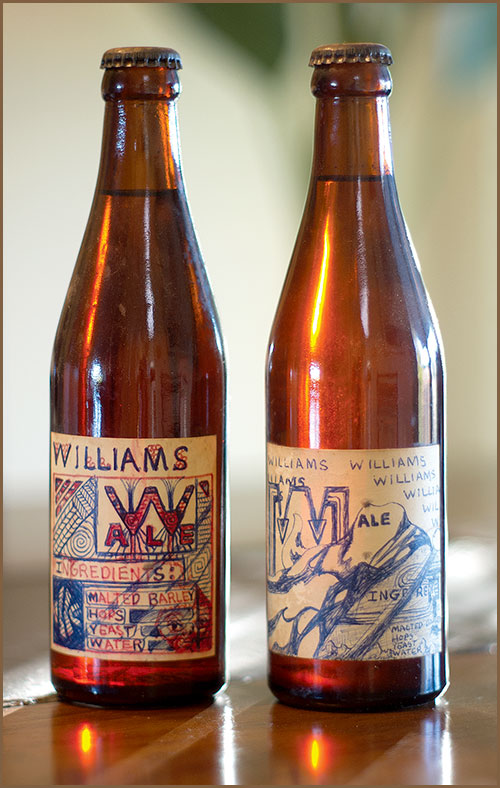 only needed to use a teaspoon). We proceeded to mash this in a large enamel kettle, and then using a straining bag, awkwardly sparged it into a 30 gallon green plastic garbage can which was our sole fermenter. We sprinkled in the dry yeast, put a muslin sheet on top of the garbage can, and left it for about three weeks to ferment in my parent’s basement.
After three weeks, using a British made hydrometer, we determined that our beer was ready to bottle. We prepared a bunch of empty Bass Pale Ale and other imported beer bottles, scrubbing off the labels, and an artist friend of mine, using ball point pens of various colors, hand drew all the labels individually for the entire batch (we had a lot of time on our hands in those days). Two of these bottles survive unopened, and are pictured here.
The beer was bottled using an Italian hand capper that looked a lot like a gear puller, which had a nasty habit of occasionally chipping the bottles in the neck area, with one of its three steel hooks that grabbed the bottom of the bottles crown for crimping leverage. Trying the beer after a couple weeks, we noted in addition to a yeasty taste, it had a sharp acidic bite, no doubt caused by the large amount of citric acid used. It had a lot of character though, and there was a malt flavor that came through that was completely absent from the insipid commercial beers of the day.
I began to be aware that home brewing was illegal nationwide, and even though Wine and the People sold brewing supplies, beer was not legal to make in the United States. I wondered about this and how this could be. After a couple of batches, we started to improve, and I was hooked. One day in late 1978 I was reading the newspaper and it said something about home brewing being legalized in most states nationwide. Being a history major, I dreamed of becoming a writer, and had been writing pieces for local newspapers in preparation for trying to get a job at a newspaper or somewhere when I could write and make a living. Judging by the few dollars I was making for each story I painstakingly wrote, I realized being a writer was going to be a tough road.
Shortly after hearing of legalization, I hatched a plan in early 1979 – I would write a book about how to make beer at home, get it published somehow, and also sell a beginning home brewing kit based on the instructions of this book by mail order out of my Oakland apartment. This way I could write and make a living. William’s Brewing was born.